

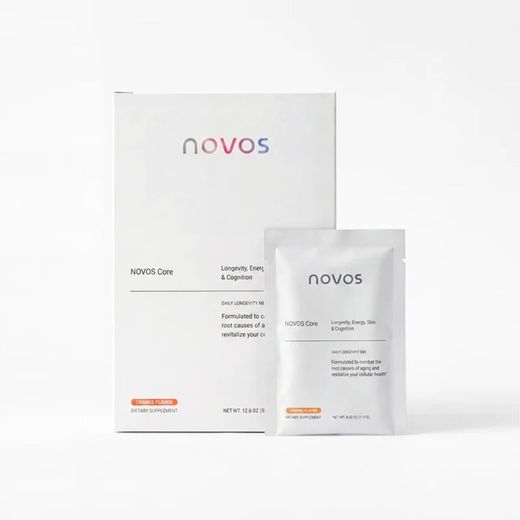
NOVOS Core vs. Leading Heart-Health Supplements: A Comprehensive Review
Methodology Framework and Competitive Evidence Analysis
Executive Summary
To evaluate the landscape of cardiovascular health interventions, NOVOS conducted a rigorous systematic review of the clinical literature covering the 14 leading supplement ingredients marketed for heart health. From an initial pool of 3,388 screened records, we identified 147 eligible randomized controlled trials involving healthy adult populations.
We then directly compared the outcomes of these studies with the clinical trial data for NOVOS Core across three key cardiovascular biomarkers: systolic blood pressure (SBP); pulse wave velocity (PWV), a measure of arterial flexibility; and flow-mediated dilation (FMD), an indicator of endothelial function. Across these endpoints, NOVOS Core demonstrated exceptional performance, achieving a larger effect size than 89% of the 55 individual study–biomarker comparisons measured under the same fasted conditions as our own trial, and 96% of all 171 comparisons included in our analysis. This report presents our comprehensive research methodology, including search strategies, inclusion criteria, and the empirical findings that underpin these conclusions.
Key Takeaways
The NOVOS Scientific Team conducted a systematic review of 147 placebo-controlled trials of 14 popular heart health ingredients in healthy adults. 110 of them found no significant effect.
In a six-month randomized trial, NOVOS Core improved flow-mediated dilation by 2.9 points, lowered pulse wave velocity by 1.18 m/s, and lowered systolic blood pressure by 6.1 mmHg compared with placebo.
In like-for-like fasted comparisons, NOVOS Core’s effect was larger in 49 of 55 comparisons (89%).
Omega-3 was the only other ingredient in this review with significant results on all three markers, and no single omega-3 trial improved all three at once.
These comparisons come from separate studies, not a head-to-head trial.
Contents
1. Objective and Scope of the Review
Individuals seeking a heart-health supplement encounter numerous single-ingredient alternatives, including magnesium, omega-3, garlic, CoQ10, and beetroot. Our objective was to evaluate a single question with scientific rigor: How does the multi-ingredient formulation of NOVOS Core perform against each individual ingredient regarding critical cardiovascular health outcomes?
Comprehensive tracking of both successful outcomes and null effects ensures the integrity of the comparison and eliminates positive-result selection bias.
2. NOVOS Core: Clinical Evidence and Benchmark Results
The comparator is the NOVOS Core randomized controlled trial, peer-reviewed and published in European Heart Journal Open (Piercy C, Heiss C, et al., 2026; doi:10.1093/ehjopen/oeag157; NCT06145087). It was a double-blind, placebo-controlled trial in 61 apparently healthy adults over 40 (mostly normal blood pressure, no established cardiovascular disease), run over six months. We use its between-group, placebo-adjusted results as the fixed yardstick every competitor is measured against:
● Endothelial function (FMD): +2.9 percentage points (95% CI 2.1 to 3.8; p<0.0001)
● Arterial flexibility (carotid-femoral PWV): −1.18 m/s (95% CI −2.00 to −0.36; p=0.006)
● Systolic blood pressure (SBP): −6.1 mmHg (95% CI −10.9 to −1.3; p=0.014).
All three were measured fasted, in apparently healthy adults, over six months (sustained). The trial also reported an acute effect one hour after the first dose (FMD +3.9 pp vs placebo), which we compare only against competitors’ acute results. Blood lipids were unchanged.
3. The Biomarkers: FMD, PWV, and Systolic Blood Pressure


Systolic Blood Pressure (SBP): Representing the standard top number in blood pressure metrics, SBP is a highly actionable clinical endpoint and a primary driver of long-term cardiovascular risk. Lower measurements indicate superior vascular health.
Endothelial Function (FMD): Flow-mediated dilation determines the capacity of the inner lining of a vessel to expand as blood flow intensifies. Higher values point to healthier, more responsive arterial walls.
Arterial Flexibility (PWV): Pulse wave velocity tracks the elastic properties of large blood vessels. Flexible arteries carry the pulse more slowly, so a lower value means more flexible arteries. Carotid-femoral PWV represents the clinical gold standard for checking arterial flexibility and serves as a reliable indicator of cardiovascular aging.
These three endpoints were evaluated in the NOVOS Core trial and represent some of the vascular outcomes most frequently documented in clinical supplement research. A clinical trial qualified for inclusion if it assessed at least one of these three metrics.
4. Search Scope, Methodology, and Queries

We assessed 14 ingredients, the iHerb “Heart” category, plus dietary nitrate/beetroot, added at the team’s request as a strong vascular comparator (combination “Heart Support Formulas” were excluded due to the general lack of studies). For every ingredient, we ran a PubMed search built from three blocks: the ingredient terms, a vascular-outcome block, and a study-design filter. The census date was 8 June 2026.










The Query Structure
RCT search:
Outcome block:
Systematic-review / meta-analysis search:
No species, date, language, or human filter was applied at the query level. The searches were deliberately high-sensitivity, and out-of-scope records (non-human, non-English, off-topic) were removed by hand at screening. We record this explicitly because it affects reproducibility: Re-running the queries without a humans[MeSH] or English[lang] limit is required to reproduce the raw-hit counts below. In parallel, we reference-mined the systematic reviews each search returned, screening their included-study lists for primary trials the main query missed, which is why the final included set is larger than the PubMed census alone.
The 14 Ingredient-Term Blocks
| Ingredient | PubMed ingredient-term block |
|---|---|
| Omega-3 / Fish Oil | (omega-3 OR “omega 3” OR n-3 PUFA OR fish oil OR EPA OR DHA OR eicosapentaenoic OR docosahexaenoic) |
| Krill Oil | krill oil |
| Magnesium | magnesium |
| Garlic | (garlic OR Allium sativum OR allicin OR aged garlic extract) |
| L-Carnitine | (L-carnitine OR acetyl-L-carnitine OR propionyl-L-carnitine) |
| L-Arginine | (L-arginine OR arginine) |
| Hawthorn | (hawthorn OR Crataegus) |
| Spirulina | spirulina |
| Vitamin B9 / Folate | (folic acid OR folate OR vitamin B9) |
| Red Yeast Rice | (red yeast rice OR Monascus OR monacolin OR Xuezhikang) |
| Lecithin | (lecithin OR phosphatidylcholine) |
| Nattokinase | nattokinase |
| Beetroot / Nitrate | (beetroot OR beet root OR beetroot juice OR dietary nitrate OR inorganic nitrate) |
| Coenzyme Q10 / Ubiquinol | (coenzyme Q10 OR ubiquinone OR CoQ10 OR ubiquinol) |
5. Search Results by Ingredient
Every returned record was screened individually, a full census, not a sampled subset. The table reproduces the workbook reconciliation exactly: the PubMed raw hits, the RCTs added through reference-mining, and the total included, split into significant and null results.
| Ingredient | Raw hits | SRs matched | RCTs ref-mined | Total incl. | Sig. | Null |
|---|---|---|---|---|---|---|
| Omega-3 / Fish Oil | 651 | 17 | 5 | 32 | 4 | 28 |
| Krill Oil | 6 | 1 | 3 | 5 | 0 | 5 |
| Magnesium | 570 | 12 | 16 | 14 | 4 | 10 |
| Garlic | 107 | 7 | 0 | 5 | 0 | 5 |
| L-Carnitine | 61 | 3 | 1 | 2 | 0 | 2 |
| L-Arginine | 1,062 | 4 | 1 | 6 | 1 | 5 |
| Hawthorn | 44 | 0 | 0 | 0 | 0 | 0 |
| Spirulina | 20 | 0 | 0 | 2 | 0 | 2 |
| Vitamin B9 / Folate | 298 | 3 | 4 | 12 | 4 | 8 |
| Red Yeast Rice | 45 | 0 | 0 | 0 | 0 | 0 |
| Lecithin | 39 | 0 | 0 | 1 | 0 | 1 |
| Nattokinase | 9 | 0 | 0 | 1 | 0 | 1 |
| Beetroot / Nitrate | 375 | 11 | 17 | 65 | 23 | 42 |
| Coenzyme Q10 / Ubiquinol | 101 | 4 | 0 | 2 | 1 | 1 |
| TOTAL | 3,388 | 62 | 47 | 147 | 37 | 110 |
In numbers: 3,388 raw PubMed hits → 3,384 screened → 3,257 excluded, with 4 records unscreenable (no abstract returned by PubMed). That left 127 inclusions from the PubMed census plus 20 added via reference-mining = 147 qualifying RCTs (37 significant / 110 null). Hawthorn and Red Yeast Rice yielded no qualifying trials. From these 147, 142 unique competitor studies entered the head-to-head database (a few report on the same cohort or fall outside the sustained-vs-sustained match), producing 171 study-marker comparisons, 123 on blood pressure, 12 on arterial flexibility, 36 on endothelial function. Of these, 55 were measured under fasted conditions and form the like-for-like comparison set used throughout the results: 36 on blood pressure, 8 on arterial flexibility and 11 on endothelial function (Figure 1).
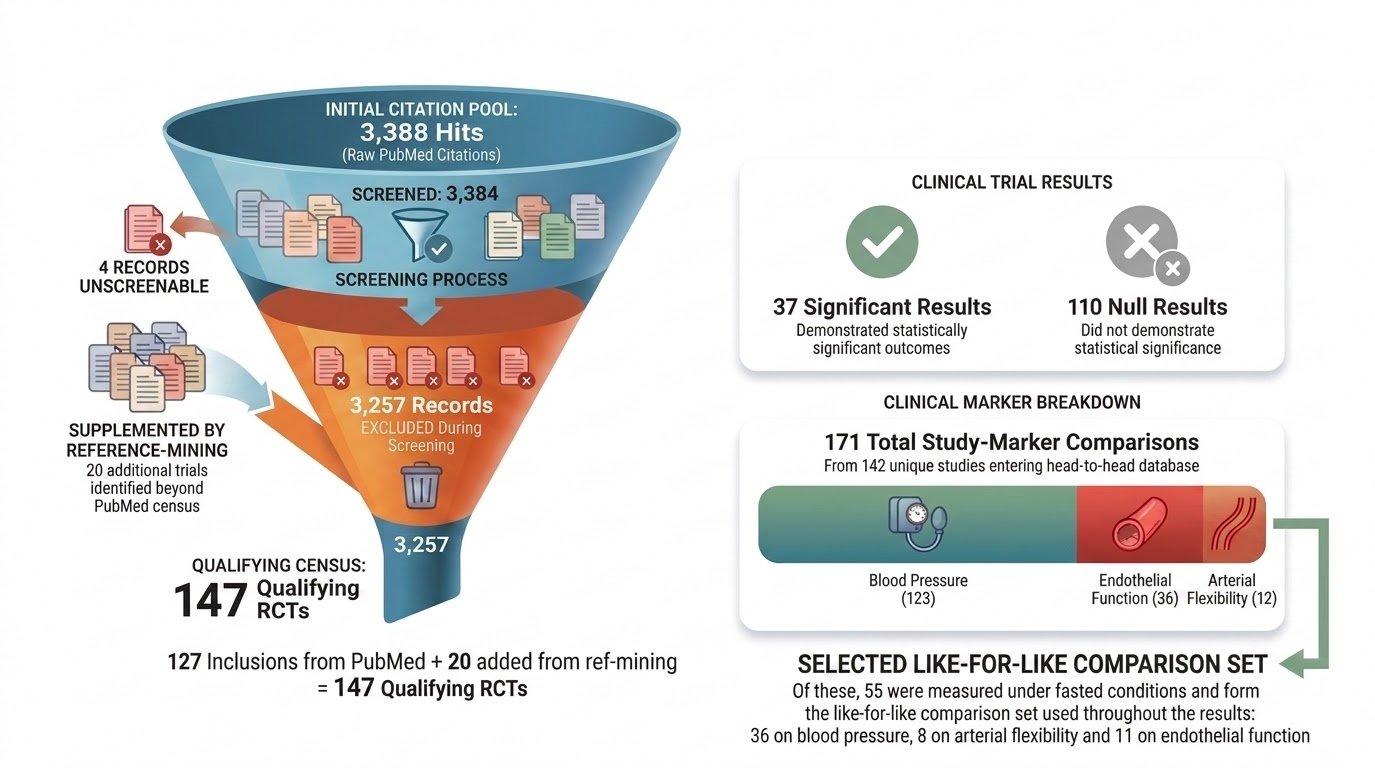
Figure 1. Flowchart of the study selection process. Out of 3,388 total records identified across 14 separate ingredients, 3,257 were omitted during the screening phase, resulting in 147 qualifying RCTs. Ultimately, 142 unique competitor trials (accounting for 171 individual study-marker comparisons) were incorporated into the head-to-head analytical database, of which 55 comparisons were measured under fasted conditions and form the like-for-like comparison.
6. Eligibility and Study Selection Criteria


A clinical study was selected for inclusion only if it satisfied all four of the following benchmarks simultaneously:
Population: Evaluated apparently healthy adult cohorts with normal blood pressure and no established cardiovascular disease, although overweight or obese individuals were permitted.
Single Ingredient: Focused strictly on a single ingredient along with its standard chemical forms or salts, excluding multi-component combination products.
Control Design: Compared a discrete, standalone dietary supplement directly against an inert control or placebo group.
Outcome Metrics: Documented empirical measurements for at least one of the three core vascular markers: FMD, PWV, or SBP.
The determination of inclusion was never influenced by statistical significance; if a study met all four criteria, it was integrated into the database regardless of its findings, and its numerical outcomes were recorded directly.
7. Study Screening, Data Extraction, and Quality Control
Every record was retrieved and screened individually. For each one we extracted citation, journal, year, design, sample size, population, intervention (substance, dose, form; single vs combination), comparator, duration, biomarkers measured, and the reported between-group effect for each marker, then tagged it Include or Exclude with a reason. Full text was read for every survivor and to resolve any ambiguous abstract.
Process and Reviewer
Screening and structured extraction were performed with an AI-assisted retrieval-and-extraction workflow operating directly on PubMed metadata and abstracts under fixed rules, with human review of every verdict and a human full-text verification pass acting as the second-reviewer step.
Removing Keyword False-Positives
Reading the actual text removes keyword collisions that a naive search would wrongly include. Examples we caught and excluded:
● “EPA” meaning the US Environmental Protection Agency (not eicosapentaenoic acid);
● “SBP” meaning the subbasal nerve plexus (not systolic blood pressure);
● “Hawthorn” as a place or person’s name; “natto” auto-expanding to soy foods generally;
● perindopril-arginine salt, and the L-NMMA / L-NAME / ADMA reagents, surfacing under “arginine”;
● MitoQ is mistaken for standard CoQ10 / ubiquinol; L-citrulline / watermelon is mistaken for L-arginine.
Retracted articles were flagged, and combination products were excluded for single-ingredient attribution.
8. How We Built the Head-to-Head Comparison
Only the between-group, placebo-adjusted difference is included, that is, the change in the supplement group relative to the change in the placebo group. Within-group changes are not used. This is important because a change from baseline in the supplement group alone can reflect factors unrelated to the supplement, including placebo effects, normal variation over time, and changes in behavior that can occur when people participate in a study, such as improvements in diet, sleep, or exercise. Subtracting the placebo group removes all of that and leaves only what the supplement itself did. Within-group numbers are almost always the larger, more flattering ones, which is precisely why we do not use them, for competitors or for NOVOS Core. Each number is tagged “Extracted” (printed verbatim in the paper, quoted in the source cell) or “Derived” (computed from the per-arm changes, with the arithmetic shown); nothing is invented, and a marker not measured is “not reported.” Units are harmonised to mmHg, m/s and percentage points.
Two rules keep it conservative. First, fasted, like-for-like. Blood pressure and blood-vessel readings shift after a meal: eating temporarily changes blood flow and vessel tone, so a measurement taken an hour or two after food is not comparable to one taken on an empty stomach. NOVOS Core was measured fasted, the stricter and more standardised of the two conditions. So, a competitor only counts as beating us if it, too, was measured fasted; a trial measured shortly after a meal or a dose, or one that never states the condition, does not count as a win against us. The effect of this rule is to hold our own result to the tougher comparison rather than an easier one. Second, a significant blood-pressure drop that appears only in a post-hoc subgroup, such as an older, higher-baseline, or single-sex subset, while the trial’s whole-cohort result is non-significant, does not count as a win. The study is scored on its primary, whole-sample between-group result (which in those cases is null), because a subgroup-only finding reflects greater room-to-improve or multiple testing rather than a generalisable effect. A genuine significant reduction in the full cohort still counts, including in healthy older adults. Finally, when a between-group result is non-significant, its “advantage” cell reads “NS, no proven effect,” because a non-significant result is treated as no demonstrated effect regardless of the point estimate.
9. Comparative Results
9.1 Evaluation Against the ‘Heart Health’ Supplements
To establish a standardized “typical supplement” baseline for each metric, we synthesized numerical findings from all heart-health supplement studies, accounting for both positive results and null effects. In alignment with our overall methodology, this benchmark is derived exclusively from studies conducted under fasted conditions, providing a like-for-like comparison for evaluating NOVOS Core’s performance (Figures 2a and 2b).
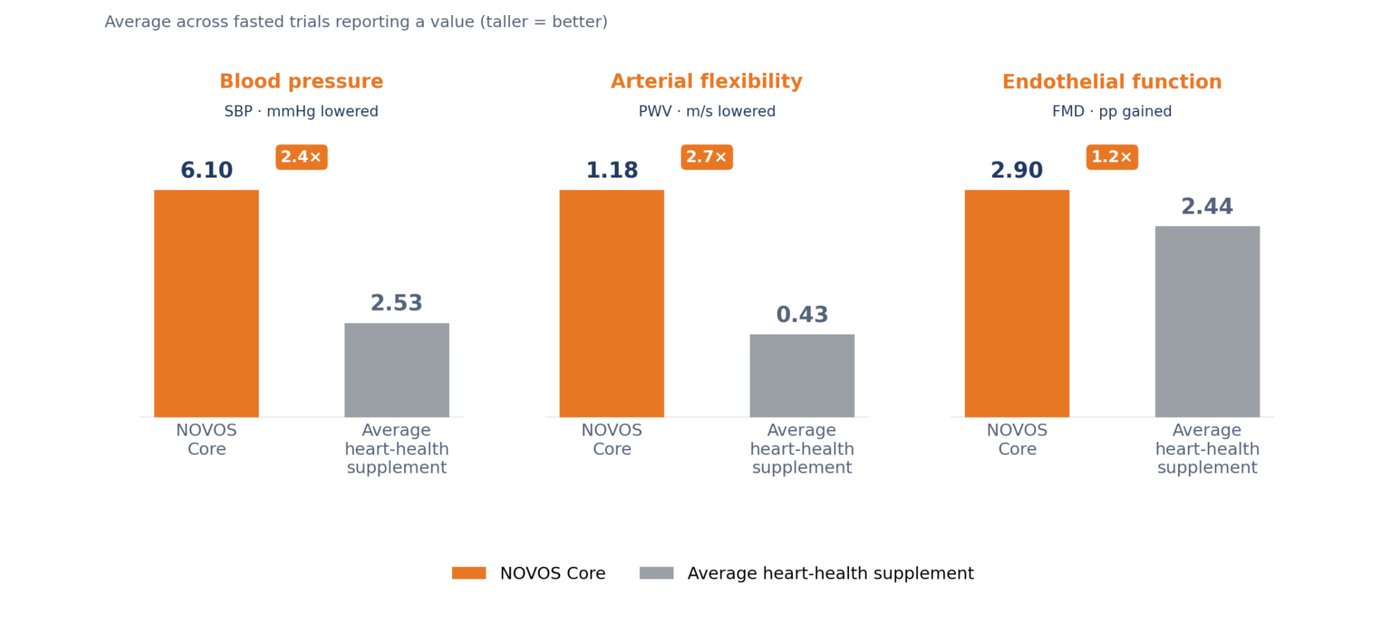
Figure 2a. Performance of NOVOS Core compared to the average heart-health supplement across specific markers under fasted conditions (orange = NOVOS Core, grey = industry average). The number of fasted trials averaged for each marker is shown beneath the pair.
On average, across trials measured fasted, standard supplements reduce blood pressure by 2.53 mmHg, improve endothelial function by 2.44 pp, and improve arterial flexibility by 0.43 m/s. NOVOS Core is 2.4× larger on blood pressure, 2.7× larger on arterial flexibility and 1.2× larger on endothelial function (−6.1 mmHg, −1.18 m/s and +2.9 pp).
Figure 2b shows the individual trials behind those averages.

Figure 2b. The distribution of fasted results. Each dot is one competitor comparison measured under fasted conditions; the dashed orange line is the NOVOS Core benchmark. Green = a statistically significant competitor result; grey = no significant effect. Non-significant comparisons that reported no numerical value are plotted at zero.
9.2 Arterial Flexibility (PWV): NOVOS Core Beats Everyone
Figure 3 is deliberately not restricted to fasted trials. Every arterial-flexibility comparison in the database is shown, including those measured without a fasting requirement, conditions under which a competitor’s result is more likely to look larger, not ours. NOVOS Core still outperforms all 12.

Figure 3. Arterial flexibility (PWV). Each bar is a trial’s placebo-adjusted change in pulse wave velocity (m/s); the further left, the greater the improvement. Orange = NOVOS Core; green = a competitor with a statistically significant effect. Bars are drawn only for significant results: a trial with no significant effect is marked NS and given no bar, because a non-significant result is treated as no demonstrated effect regardless of its point estimate.
With a placebo-adjusted reduction of −1.18 m/s, NOVOS Core achieved the most substantial improvement in arterial flexibility among all evaluated products, outperforming 100% of the 12 comparison trials. Within those comparison studies, statistical significance was observed by only two ingredients in a single clinical trial (being non-significant on all the other instances that they were tested): magnesium (−1.0, following closely) and omega-3 (−0.20, which demonstrated an effect approximately six times weaker).
9.3 Outperformance Across the Field (94 / 100 / 64%)
To evaluate outperformance, each individual study was analyzed marker by marker to determine whether NOVOS Core exceeded the competitor’s results. A trial was classified as a win for NOVOS Core if the competitor either failed to demonstrate a statistically significant effect or produced a significant effect that was smaller than ours. Conversely, a comparison was counted against us only if the competitor achieved a statistically significant, larger effect under fasted conditions (Figure 4).

Figure 4. Comparison of outperformance by biomarker. Each bar indicates the proportion of fasted competitor comparisons surpassed by NOVOS Core: 94% for blood pressure, 100% for arterial flexibility, and 64% for endothelial function.
Restricting the comparison to trials measured under the same fasted conditions as NOVOS Core, the like-for-like set, it delivers superior outcomes in 94% of blood-pressure comparisons (34 of 36), 100% of arterial-flexibility comparisons (8 of 8), and 64% of endothelial-function comparisons (7 of 11), or 89% across all 55 fasted comparisons. Across the full database of 171 comparisons, fasted and non-fasted together, it surpasses 96% of the field. No other ingredient outperforms it on more than a single marker among the three analyzed.
9.4 Potency Evaluation Across All Three Biomarkers
This analysis evaluates the magnitude of each ingredient’s effect when a significant result is achieved, calculating the mean of its successful trials and benchmarking it against NOVOS Core. The scoring system reflects relative strength: three bars denote matching or exceeding our performance; two bars indicate at least half of the effect; one bar represents a weak impact; ✗ signifies tested with no statistically significant outcome; and (–) indicates an absence of testing (Figure 5).

Figure 5. Scorecard evaluating effect strength. A higher number or taller bars indicate a more robust average effect compared to NOVOS Core (three bars signify matching or exceeding it; two represent at least half the effect size; one indicates a weak impact); a cross denotes testing that yielded no significant effect, while a dash indicates the marker was not tested. NOVOS Core (orange) stands out as the sole supplement demonstrating full strength across all three markers.
In successful clinical trials, certain supplements such as omega-3, beetroot, and folate match the performance magnitude of NOVOS Core on blood pressure and endothelial function, reflecting their respective scores. Nevertheless, none of these alternatives successfully satisfies all three parameters. NOVOS Core remains unique in achieving full-strength efficacy across all three cardiovascular markers at the same time, and it is the exclusive option to demonstrate maximum strength for arterial flexibility.
9.5 Direct Comparison With Omega-3
As the sole competitor demonstrating significant outcomes across all three biomarkers, omega-3 serves as our most rigorous and equitable benchmark. Using its optimal scenario, the mean of only its statistically significant results, would flatter it, because that silently discards every trial in which omega-3 did nothing. Instead, we aggregated data across every omega-3 study measured under fasted conditions that reported numerical values, incorporating both positive outcomes and null effects, and compared that directly against NOVOS Core across each individual metric (Figure 6).
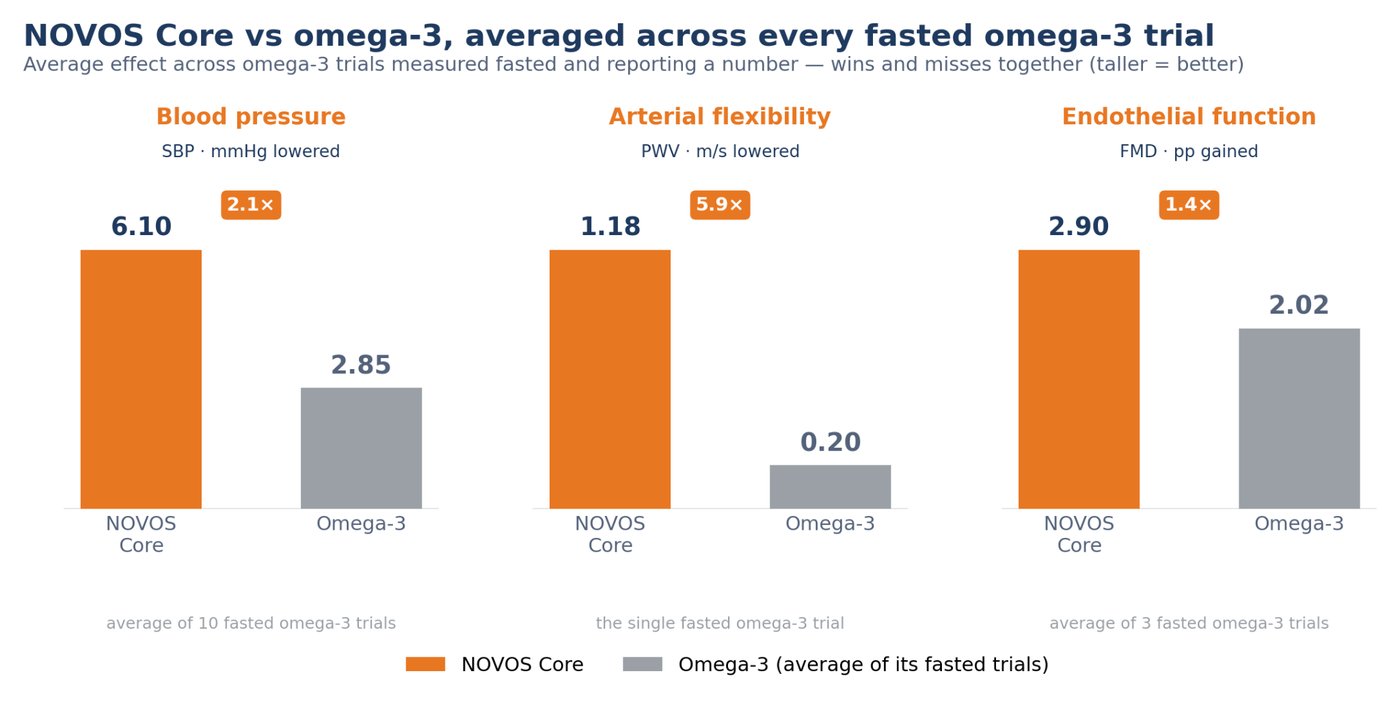
Figure 6. Head-to-head comparison: NOVOS Core vs. omega-3. Values represent the average effect across every omega-3 trial measured under fasted conditions that reported a numerical value, incorporating both positive outcomes and null effects; orange = NOVOS Core, grey = omega-3. The number of fasted omega-3 trials averaged is indicated below each pair.
Averaged across its fasted trials, omega-3 lowers systolic blood pressure by 2.85 mmHg, less than half of NOVOS Core’s 6.1 mmHg. On arterial flexibility, it does produce a genuine improvement of 0.20 m/s, but that is roughly six times weaker than NOVOS Core’s −1.18 m/s. For endothelial function, the two are closer (2.02 vs 2.90 pp), yet omega-3 reaches that level in only two of its three fasted trials, and in no single study does it improve all three biomarkers at once: its most successful single trial demonstrated progress in only two of the three metrics.


10. Summary of Clinical Evidence
The heart-health shelf is crowded, and nearly every bottle can point to a study. The NOVOS science team screened 3,388 PubMed records on 14 popular heart-health ingredients, including omega-3, magnesium, garlic, and beetroot, and identified 147 randomized, placebo-controlled trials in healthy adults. The first surprise was that 110 of those 147 trials found no significant effect on the heart markers they measured. To keep the comparison fair, the review counted only the difference between each supplement group and its placebo group. It also kept only trials measured on an empty stomach, since a meal can shift blood pressure and blood vessel readings. That left 55 strict, like-for-like comparisons across three markers: systolic blood pressure, arterial flexibility (pulse wave velocity), and endothelial function (flow-mediated dilation).
So, what did the NOVOS Core trial show? For six months, healthy adults over 40 took either NOVOS Core or a placebo, and neither the participants nor the researchers knew who was getting which. The trial’s main measure, flow-mediated dilation, improved by 2.9 points more on NOVOS Core than on placebo, a sign of blood vessels that widen more readily as blood flow increases. Pulse wave velocity fell by 1.18 m/s more than on placebo, meaning the pulse traveled more slowly through the large arteries, the pattern seen in more flexible vessels. Systolic blood pressure was 6.1 mmHg lower than on placebo, in people whose blood pressure started and stayed within the normal range. All three differences were statistically significant. In an exploratory analysis of everyone on NOVOS Core with complete six-month data, 95.7% improved on at least two of the three markers.
Against the rest of the field, those results stood out. NOVOS Core’s effects were 2.4×, 2.7× and 1.2× the average supplement trial, and NOVOS Core came out ahead in 49 of 55 comparisons (89%). Omega-3, the only other ingredient with significant results on all three markers, averaged less than half of NOVOS Core’s effect on blood pressure, and no single omega-3 trial improved all three at once. NOVOS Core was the only supplement in the review to show a full-strength effect on all three markers together.
This review was conducted by NOVOS Science & R&D. The comparisons come from separate published studies with different designs, doses, and durations, not a head-to-head trial. NOVOS Core supports healthy blood pressure already within the normal range. Individual results will vary, and some people will see no benefit. These statements have not been evaluated by the Food and Drug Administration. This product is not intended to diagnose, treat, cure, or prevent any disease.
11. Limitations and Interpretation
We maintain complete transparency regarding the constraints of this study. The primary census relies solely on the PubMed database, a restriction we have partially counterbalanced by mining references from retrieved systematic reviews. Screening encompassed a complete census of every returned entry, backed by a record-level reconciliation audit. Initial screening was performed at the abstract level, and subsequent verification confirmed all numerical data against full-text PDFs. Furthermore, the fixed benchmark for comparison is a single trial: the NOVOS Core study, peer-reviewed and published in European Heart Journal Open (2026), with 61 participants randomized and 43 analyzed. A single, relatively small trial gives a less precise estimate than an average across many studies, and its results have not yet been replicated. Finally, our methodology is designed to record statistical significance rather than use it as a filter. Because a null result for a single ingredient remains informative, this approach helps prevent positive-result selection bias.
12. Studies Included in the Review
Every trial evaluated is listed below: 142 unique competitor RCTs plus the NOVOS Core trial (142 references), organised by ingredient, each with the endpoint(s) it measured, whether the result was significant, and a direct PubMed link.
NOVOS Core Competitive Evidence: Full Reference List
142 competitor studies, organized by ingredient. Each entry is tagged (significant) or (no significant effect) for the vascular marker(s) it was scored on, with a PubMed or DOI link.
Prepared by the R&D Department
Susana Chumbo