
Sleep · Recovery · Healthy Aging
Why You Can Sleep 8 Hours and Still Wake Up Tired
Falling asleep is only one part of a good night. Staying asleep, sleep architecture, and waking up feeling restored all matter too, and they do not always go wrong for the same reason.
Some sleep problems are obvious.
You get into bed tired, then spend the next hour staring at the ceiling.
Or you fall asleep quickly, wake at 3:17 a.m., and realize twenty minutes later that your brain has apparently decided the night is over.
Others are much harder to understand.
You go to bed at a reasonable hour. Your tracker says you were asleep for seven or eight hours. You did everything that was supposed to count as “getting enough sleep.”
And yet the alarm feels brutal.
Your head is foggy. Your energy is flat. Your wearable says deep sleep was low again, or your REM graph looks strangely abbreviated.
You slept.
But you do not feel restored.
We tend to compress all of these experiences into two words:
“poor sleep.”
The problem is that sleep is not one biological event.
And if different parts of your night can break down for different reasons, trying to solve all of them with the same bedtime trick does not make much sense.
“Sleep is not one problem.”
Falling asleep, staying asleep, sleep architecture, total sleep duration and next-morning restoration are connected.
They are not interchangeable.
Persistent sleep problems are more common than most people realize
In 2025, researchers published a large meta-analysis examining the prevalence of insomnia disorder in the general population.
Their estimate using structured diagnostic interviews was striking:
12.4%
of adults met criteria for insomnia disorder.[1]
Each mark represents one adult in one hundred.
That is not the percentage of people who occasionally have a bad night.
Chronic insomnia involves persistent difficulty initiating sleep, maintaining sleep or waking earlier than intended despite adequate opportunity to sleep, together with meaningful daytime consequences.
Many more people experience intermittent or subclinical sleep problems.
So if sleep occasionally feels more fragile than it used to, you are hardly alone.
The sleep problem picture
Select a category to read what it usually means.
Falling asleep
You are tired, but sleep takes much longer to arrive than you want.
Staying asleep
You fall asleep, but wake repeatedly or spend long periods awake during the night.
Waking too early
Your night ends before you intended and sleep does not return.
Not enough total sleep
There may be nothing unusual about the sleep itself. There simply was not enough time allocated to it.
Deep or REM sleep concerns
Your wearable says one stage looks low or inconsistent.
Waking unrefreshed
The quantity appears adequate, but the night does not feel restorative.
That distinction matters.
Someone who cannot sleep because they drink caffeine at 5 p.m. does not necessarily have the same problem as someone whose sleep is being fragmented by untreated sleep apnea.
And someone getting six hours because they repeatedly choose a midnight bedtime with a 6 a.m. alarm does not primarily have a supplement problem.
Sometimes the first step toward better sleep is simply identifying which part is actually going wrong.
A night is not one continuous state
You do not enter “sleep” at bedtime and remain in one uniform biological state until morning.
Healthy sleep moves through repeating stages.
After falling asleep, the brain progresses through lighter non-REM sleep, deeper slow-wave sleep, and REM sleep. These stages cycle multiple times across the night.[2]
Deep sleep, also known as N3 or slow-wave sleep, tends to be concentrated more heavily earlier in the night.
REM sleep becomes progressively more prominent during later cycles.
That means eight hours is more than simply a quantity.
The structure of those eight hours matters too.
Conceptual sleep architecture · illustrative eight-hour night, not individual medical data
Deep sleep clusters early; REM lengthens later in the night.
Deep sleep tends to change the most with age
Deep sleep attracts enormous attention because consumer wearables make it feel quantifiable.
And there is a real biological reason people may notice changes over time.
A large meta-analysis of objective sleep measurements found that slow-wave sleep tends to decline with age. Sleep efficiency also tends to decrease, while the amount of time spent awake after initially falling asleep tends to rise.[2]
In other words, healthy sleep often becomes somewhat lighter and more fragmented as people get older.
But this should not turn one night’s estimated “deep sleep minutes” into a grade.
There is no universal deep-sleep percentage that every healthy adult should hit every night.
Age matters. Genetics matter. Exercise matters. Schedule matters. Health matters.
And, importantly, the accuracy of the device doing the measuring matters.
REM sleep is different
REM is not simply another version of deep sleep.
The brain is highly active during REM, while the body undergoes characteristic changes in muscle tone and eye movement.
REM has been implicated in functions including aspects of memory and emotional processing.
Its proportion changes less dramatically across adulthood than slow-wave sleep does.[2]
But there is an important timing issue.
Because REM episodes tend to lengthen toward the latter part of the night, repeatedly cutting sleep short may disproportionately reduce the opportunity to complete those later cycles.
So going to bed two hours later and assuming you can simply “sleep harder” is not how the system works.
Your sleep tracker is useful. It is not a sleep lab.
Wearables have transformed the way people think about sleep.
That is mostly a good thing.
They can make bedtime inconsistency obvious.
They can show how late nights accumulate.
They can reveal long-term trends that would otherwise be difficult to notice.
But consumer devices estimate sleep.
Clinical polysomnography directly measures signals including brain activity, eye movement and muscle activity.
A 2025 meta-analysis comparing 24 studies and 798 people found significant differences between consumer wrist-worn trackers and polysomnography for measures including total sleep time, sleep efficiency, sleep latency and wakefulness after sleep onset.[3]
A 2026 review of real-world consumer sleep technologies similarly concluded that stage classification and measures such as sleep efficiency and nighttime wakefulness remain less precise than basic estimates of time in bed or total sleep.[4]
Show me the science
Reference [3] pooled 24 studies covering 798 participants, comparing consumer wrist-worn devices against polysomnography, the clinical reference standard. Differences were reported for total sleep time, sleep efficiency, sleep-onset latency and wake after sleep onset.
The practical takeaway is not to throw away your tracker.
It is to use it differently.
“Watch the trend. Don’t grade every night.”
If your device says you had 43 minutes of deep sleep tonight and 71 minutes tomorrow, your biology did not necessarily transform in 24 hours.
Pay attention to persistent patterns.
And pay attention to the metric no wearable needs to estimate:
How do you actually feel?
Before buying anything, look for the obvious disruptors
There is something appealing about the idea that poor sleep is caused by one missing ingredient.
Sometimes nutrition may matter.
But sleep is also extraordinarily responsive to behavior, timing, environment and health.
The basic causes are not glamorous.
That does not make them unimportant.
1. Not enough opportunity to sleep
Most healthy adults are advised to obtain at least seven hours of sleep regularly.[5]
Some people need more.
If your body functions best with eight hours and your schedule repeatedly allows six, no supplement can manufacture the missing two hours.
“You cannot supplement your way out of a night you never gave yourself time to sleep.”
2. Circadian timing
Being exhausted and being biologically ready to sleep are not always the same thing.
Your circadian system helps determine when sleep and wakefulness occur.
Light is one of its most powerful environmental signals.
Daytime light exposure and relatively consistent daily timing help reinforce the difference between biological day and night.
3. Caffeine
Caffeine sensitivity varies enormously.
For some people, an afternoon coffee causes no obvious problem.
For others, caffeine consumed many hours before bedtime can still interfere with sleep onset or sleep quality.
Coffee is not the only source.
Tea, pre-workout formulas, energy drinks, chocolate and some medications can contribute too.
If falling asleep is consistently difficult, moving caffeine earlier is one of the simplest variables to test.
4. Stress and cognitive arousal
You can be physically exhausted while your brain remains alert.
Work stress, rumination, anxiety and even worrying about sleep itself can create a state in which trying harder to fall asleep becomes counterproductive.
Being tired is not identical to being calm.
5. Alcohol
Alcohol can make people feel drowsier.
That does not necessarily mean it produces better sleep.
It can make falling asleep seem easier while disrupting sleep later in the night.
Sedation and restorative sleep are not the same biological goal.
6. The room
Temperature. Light. Noise. An uncomfortable mattress. A snoring partner. A phone vibrating three feet from your head.
Sleep remains sensitive to the environment around you.
A cool, dark, quiet bedroom is boring advice. It is still good advice.
Start with the things that move sleep the most
If your sleep needs work, start with the foundations before assuming a supplement will solve it.
Give yourself enough time to sleep. Keep wake time reasonably consistent. Get light during the day. Exercise regularly. Move caffeine earlier if necessary. Make the bedroom cool, dark and quiet.
Time
Enough hours allocated to sleep, not just enough hours in bed.
Timing
A reasonably consistent wake time anchors the whole system.
Light
Daytime light separates biological day from biological night.
Movement
Regular exercise supports sleep and daytime alertness.
Caffeine
Move it earlier if falling asleep is consistently difficult.
Environment
Cool, dark, quiet. Boring advice that still works.
Those interventions do not look sophisticated enough to generate an impressive supplement advertisement.
They also address some of the most fundamental systems controlling sleep.
Chronic insomnia deserves more than sleep hygiene
This distinction is important.
If sleep difficulty has become persistent, significantly interferes with daytime function, and fits the pattern of chronic insomnia, basic sleep-hygiene tips are not considered adequate treatment.
The American Academy of Sleep Medicine recommends cognitive behavioral therapy for insomnia, or CBT-I, as a first-line treatment for chronic insomnia.[6]
CBT-I uses behavioral and cognitive strategies designed specifically for insomnia.
A supplement is not a substitute for that.
And insomnia is not the only condition that can masquerade as “bad sleep.”
Loud habitual snoring, choking or gasping during sleep, witnessed breathing pauses, substantial daytime sleepiness, an irresistible urge to move the legs at night, or persistent unexplained awakenings are reasons to consider proper evaluation.
Sometimes poor sleep needs better habits. Sometimes it needs medicine. Sometimes it needs a sleep specialist. And sometimes nutritional support can complement the foundations.
So where can nutrition fit?
Once the obvious disruptors are addressed, a more interesting question appears:
Can particular nutrients or food-derived compounds meaningfully support sleep?
For several ingredients, human studies suggest the answer may be yes.
But the evidence differs enormously from ingredient to ingredient.
Some compounds have been studied primarily for sedation. Some influence circadian timing. Others appear more relevant to relaxation, subjective sleep quality, or the way someone feels after waking.
Three ingredients stand out as particularly relevant to the NOVOS Core formula:
Glycine. L-Theanine. Magnesium.
The strongest story starts with an amino acid that rarely appears on the front of a sleep-supplement bottle.
Ingredient one
Glycine has a surprisingly specific sleep story
Glycine is a small amino acid made naturally in the body and obtained from food.
It performs numerous biological functions.
But several small controlled human studies have also looked directly at sleep.
And what makes the findings particularly interesting is that researchers did not only ask: “Did people sleep?”
They also asked: “How did they feel when they woke up?”
Feeling more refreshed the next morning
In a randomized, double-blind crossover study, volunteers who complained about the quality of their sleep received glycine or placebo before bedtime.
The following morning, glycine produced significant improvements in ratings of fatigue, liveliness and “clear-headedness.”[7]
That is a different outcome from simply making someone drowsy. It speaks to restoration.
Falling asleep and reaching slow-wave sleep
A second small human study went further by including polysomnography.
Participants experiencing unsatisfactory sleep reported better subjective sleep quality with glycine.
The researchers also observed improved sleep efficiency and shorter latency both to initial sleep onset and to slow-wave sleep.[8]
Importantly, overall sleep architecture was not significantly altered.
That nuance matters. The study did not show that glycine simply created “more deep sleep.” It suggested that participants entered sleep and slow-wave sleep sooner while reporting better sleep quality.
What about the next day after too little sleep?
Researchers have also studied glycine during experimentally restricted sleep.
In healthy volunteers whose sleep was deliberately shortened, glycine was associated with reduced next-day fatigue and improved psychomotor-vigilance performance.[9]
Again, the idea is not that glycine replaces sufficient sleep. It did not give people the missing hours back.
But the next-day findings make glycine unusually interesting in the context of how restorative sleep feels.
“Sleep quality is partly about what happens after you wake up.”
Next-morning feeling
Randomized crossover study
Fatigue, liveliness and clear-headedness improved.
Show me the science
Randomized, double-blind crossover design in volunteers who reported poor sleep quality. Glycine or placebo was taken before bedtime, with next-morning subjective ratings as the outcome. Small sample. Ingredient study, not a NOVOS Core trial. Some glycine research was conducted by researchers affiliated with a glycine manufacturer.
Reference [7]
Sleep quality
Human PSG study
Improved subjective sleep quality and sleep efficiency. Shorter latency to sleep and slow-wave sleep.
Show me the science
Small human study using polysomnography alongside subjective sleep-quality questionnaires in participants with unsatisfactory sleep. Overall sleep architecture was not significantly altered. Ingredient study, not a NOVOS Core trial.
Reference [8]
Next-day performance
Controlled sleep-restriction study
Reduced fatigue and improved psychomotor vigilance.
Show me the science
Healthy volunteers underwent experimental partial sleep restriction. Outcomes included subjective daytime fatigue and psychomotor-vigilance testing. Glycine did not restore the missing sleep hours. Ingredient study, not a NOVOS Core trial.
Reference [9]
These findings are promising. They are also small studies.
Some glycine research was conducted by researchers affiliated with a glycine manufacturer.
And none of these trials studied NOVOS Core itself. That distinction will matter later.
Ingredient two
L-Theanine is more about calm than sedation
L-Theanine is an amino acid naturally present in tea.
Unlike many compounds marketed for sleep, its appeal is not based primarily on the idea of making someone heavily sedated.
It has been studied in areas including relaxation, stress and sleep.
And in 2025, researchers published one of the more useful summaries of the sleep evidence to date.
A systematic review and meta-analysis evaluated 19 randomized studies involving 897 participants.[10]
Across the pooled data, L-Theanine significantly improved three subjective sleep outcomes:
- sleep-onset latency
- daytime dysfunction
- overall subjective sleep-quality score
The size of the effects varied. And not everything improved.
Several objective measures, including objective sleep onset, total sleep duration and sleep efficiency, did not show consistent significant improvements across the pooled evidence.
That is worth emphasizing. A useful sleep ingredient does not have to improve every metric.
What about feeling restored?
A second systematic review focused specifically on studies using L-Theanine as a standalone intervention.
Across 13 eligible trials, researchers found favorable results in studies assessing areas including sleep latency, maintenance, efficiency, sleep satisfaction, and feelings of refreshment or recovery after waking.[11]
The authors also concluded that more high-quality objective research is needed.
That is a reasonable summary of the evidence: Encouraging. Human. Increasingly substantial.
But not a claim that L-Theanine transforms every aspect of sleep.
“The interesting goal is not to be knocked out. It is a calmer path into restorative sleep.”
Systematic review + meta-analysis
19 eligible RCT articles, 897 participants
Significant pooled improvements in subjective sleep-onset latency, daytime dysfunction and overall subjective sleep quality.
Show me the science
Pooled analysis of randomized controlled trial articles. Several objective measures, including objective sleep onset, total sleep duration and sleep efficiency, did not show consistent significant improvements. Ingredient evidence, not a NOVOS Core trial.
Reference [10]
Standalone L-Theanine review
13 eligible trials
Reported favorable findings across several subjective and objective sleep domains.
Show me the science
Systematic review restricted to trials using L-Theanine as a standalone supplement. Domains included sleep latency, maintenance, efficiency, satisfaction and feelings of refreshment or recovery after waking. The authors concluded more high-quality objective research is needed. Conflict of interest: several authors were affiliated with British American Tobacco Investments.
Reference [11]
Ingredient three
Magnesium is famous for sleep. The evidence is more complicated.
If there is one mineral nearly synonymous with modern sleep supplementation, it is magnesium.
Magnesium is essential for normal nervous-system function, muscle function and hundreds of enzymatic processes.
But popularity is not the same thing as certainty.
A 2021 systematic review and meta-analysis identified only three randomized trials of oral magnesium in older adults with insomnia.
The pooled analysis suggested that sleep-onset latency was shorter with magnesium.
But all three studies had meaningful risk-of-bias concerns, and the overall certainty of evidence was rated low to very low.[12]
More recently, a 2025 randomized, double-blind, placebo-controlled trial studied magnesium bisglycinate in 155 adults reporting poor sleep.
The magnesium group experienced a statistically significant improvement in insomnia-severity scores relative to placebo.
The effect was modest.[13]
Show me the science
Reference [12] pooled three randomized trials of oral magnesium in older adults with insomnia. Sleep-onset latency was shorter with magnesium, but risk-of-bias concerns were meaningful and certainty of evidence was rated low to very low. Reference [13] was a randomized, double-blind, placebo-controlled trial of magnesium bisglycinate in 155 adults reporting poor sleep, with a statistically significant but modest improvement in insomnia-severity scores. The intervention was magnesium bisglycinate, which is a different formulation from Magnesium Malate.
There is another important wrinkle:
The study used magnesium bisglycinate.
NOVOS Core contains Magnesium Malate.
Those are not the same magnesium formulation.
So it would be inappropriate to take a study of magnesium bisglycinate and claim that it proves the same specific sleep outcome for Magnesium Malate.
Magnesium remains biologically relevant and supportive.
But if we rank the Core sleep evidence on directness, Glycine and L-Theanine provide the cleaner stories.
What has actually been studied?
| Ingredient | Human evidence | Sleep-related areas studied | Our read |
|---|---|---|---|
| Glycine | Small controlled human studies | Subjective sleep quality, sleep onset, latency to slow-wave sleep, next-morning fatigue and clear-headedness | Strongest Core sleep story |
| L-Theanine | Randomized trials, systematic reviews, meta-analysis | Subjective sleep onset, sleep quality, daytime dysfunction, sleep satisfaction, morning refreshment | Strong |
| Magnesium | Randomized trials and systematic reviews | Sleep onset and subjective insomnia / sleep measures | Supporting, mixed |
| Rhodiola Rosea | Human stress and fatigue research | Stress resilience and fatigue | Indirect, not positioned as a sleep ingredient |
| Other Core ingredients | Not highlighted for sleep | Various non-sleep biological roles | Not the reason to choose Core for sleep |
A twelve-ingredient formula does not need twelve sleep claims.
For this particular benefit, the science points most clearly toward Glycine, L-Theanine and Magnesium.
The everyday option
This is where NOVOS Core becomes interesting
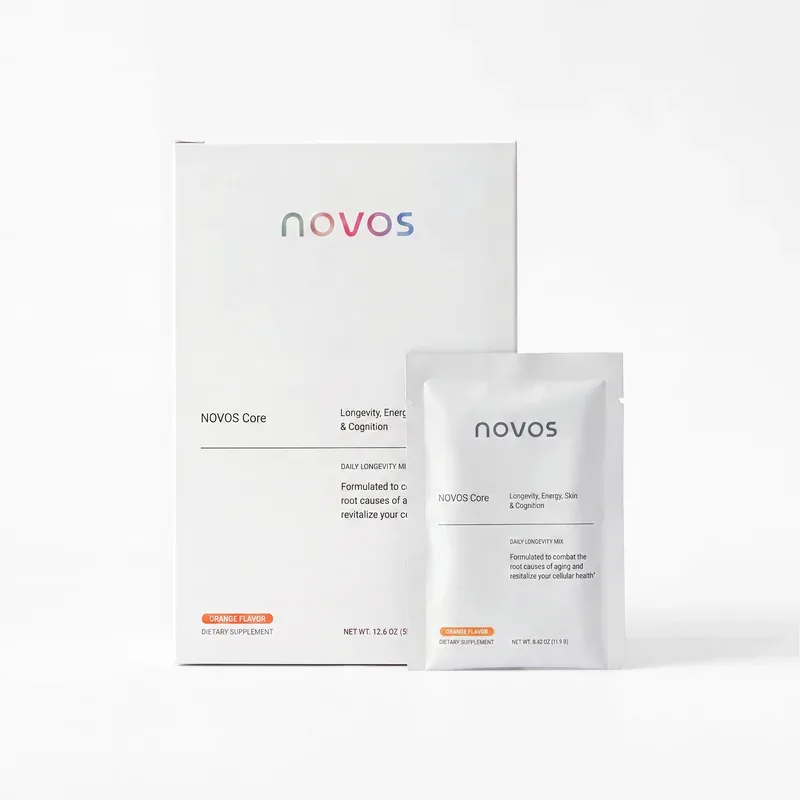
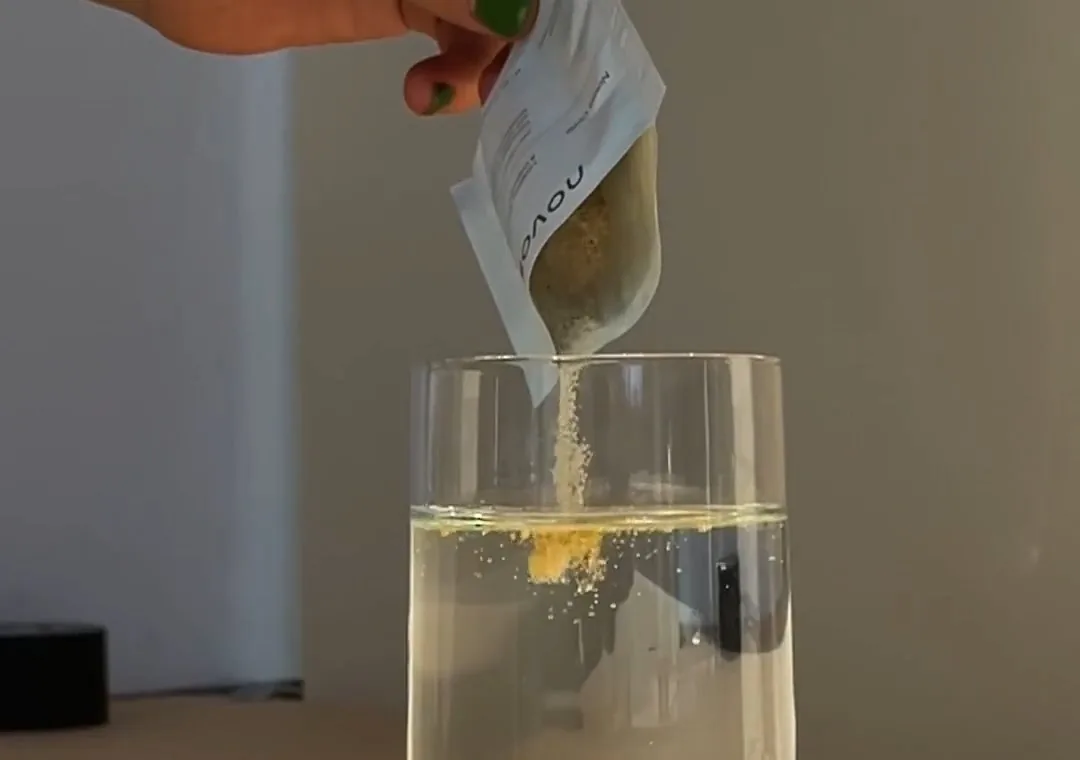
It puts Glycine, L-Theanine and Magnesium into a daily longevity formulation, alongside nine other ingredients selected for biological processes involved in healthy aging.
Core was not designed narrowly as a sleep aid. It was designed as a once-daily foundation, and sleep-relevant biology happens to be part of that foundation.
Three ingredients, one daily formula
Within NOVOS Core’s broader 12-ingredient formula, the doses relevant to this article are:
- 2,000 mg Glycine
- 150 mg L-Theanine
- 304 mg Magnesium
None of these doses have been tested for sleep as the specific formulation in NOVOS Core. The research above comes from studies of the individual ingredients, not from a NOVOS Core sleep trial.
A daily formula, not an acute sleeping pill
That distinction is worth being explicit about.
NOVOS Core is designed to be taken consistently, as part of a broader daily longevity routine, not reached for occasionally the way someone might reach for a sedative on a bad night.
If a difficult night calls for something stronger, that is a conversation for a healthcare professional, not a supplement aisle.
For NOVOS Core, that evidence begins with Glycine, L-Theanine and Magnesium.[7][10][12]
Get started
Explore NOVOS Core
A once-daily longevity formula built around Glycine, L-Theanine and Magnesium, plus nine additional ingredients selected for healthy aging.
This article is for educational purposes only. Persistent sleep difficulty, snoring, breathing pauses, restless legs or excessive daytime sleepiness can have medical causes and should be discussed with a qualified healthcare professional. NOVOS Core is a dietary supplement and is not intended to diagnose, treat, cure or prevent insomnia, sleep apnea, restless legs syndrome or any other disease.
These statements have not been evaluated by the Food and Drug Administration. This product is not intended to diagnose, treat, cure, or prevent any disease.
References
-
[1]
The Prevalence of Insomnia Disorder in the General Population: A Meta-Analysis.
Baglioni C, et al. Journal of Sleep Research. 2025.
Supports: Population prevalence of insomnia disorder and distinction from occasional poor sleep.
-
[2]
Meta-analysis of quantitative sleep parameters from childhood to old age in healthy individuals.
Ohayon MM, Carskadon MA, Guilleminault C, Vitiello MV. Sleep. 2004;27(7):1255-1273.
Supports: Age-related changes in total sleep, sleep efficiency, nighttime wakefulness, slow-wave sleep and REM.
-
[3]
Performance of consumer wrist-worn sleep tracking devices compared to polysomnography: a meta-analysis.
Lee YJ, Lee JY, Cho JH, Kang YJ, Choi JH. Journal of Clinical Sleep Medicine. 2025;21(3):573-582.
Supports: Differences between consumer sleep trackers and polysomnography for total sleep time, sleep efficiency, sleep latency and wake after sleep onset.
-
[4]
Real-World Use of Consumer Sleep Devices: A Rapid Review.
Landvatter J, Ryan JT, Depner CM, Baron K. CHEST. 2026;169(4):1101-1110.
Supports: Consumer devices are more useful for broad sleep patterns than precise sleep-stage and fragmentation measurements.
-
[5]
Recommended Amount of Sleep for a Healthy Adult.
Watson NF, Badr MS, Belenky G, et al. Journal of Clinical Sleep Medicine. 2015;11(6):591-592.
Supports: Healthy adults should regularly obtain at least seven hours of sleep.
-
[6]
Behavioral and psychological treatments for chronic insomnia disorder in adults.
Edinger JD, Arnedt JT, Bertisch SM, et al. Journal of Clinical Sleep Medicine. 2021;17(2):255-262.
Supports: CBT-I as the recommended first-line behavioral treatment for chronic insomnia.
-
[7]
Subjective effects of glycine ingestion before bedtime on sleep quality.
Inagawa K, Hiraoka T, Kohda T, Yamadera W, Takahashi M. Sleep and Biological Rhythms. 2006;4:75-77.
Supports: Randomized double-blind crossover findings involving next-morning fatigue, liveliness and clear-headedness.
Important: Ingredient study. Not a NOVOS Core trial.
-
[8]
Glycine ingestion improves subjective sleep quality in human volunteers, correlating with polysomnographic changes.
Yamadera W, Inagawa K, Chiba S, Bannai M, Takahashi M, Nakayama K. Sleep and Biological Rhythms. 2007;5:126-131.
Supports: Subjective sleep quality, sleep efficiency, sleep-onset latency, latency to slow-wave sleep and daytime outcomes.
Important: Small ingredient study. Not a NOVOS Core trial.
-
[9]
The Effects of Glycine on Subjective Daytime Performance in Partially Sleep-Restricted Healthy Volunteers.
Bannai M, Kawai N, Ono K, Nakahara K, Murakami N. Frontiers in Neurology. 2012;3:61.
Supports: Fatigue and psychomotor-vigilance outcomes during experimental partial sleep restriction.
Important: Ingredient study. Not a NOVOS Core trial.
-
[10]
The effects of L-Theanine consumption on sleep outcomes: A systematic review and meta-analysis.
Bulman A, D'Cunha NM, Marx W, Turner M, McKune A, Naumovski N. Sleep Medicine Reviews. 2025;81:102076.
Supports: Meta-analysis of 19 eligible randomized-trial articles involving 897 participants.
-
[11]
Examining the effect of L-Theanine on sleep: a systematic review of dietary supplementation trials.
Cotter J, Caddick CE, Harper JL, Ebajemito JK. Nutritional Neuroscience. 2026;29(2):224-238.
Supports: Standalone L-Theanine studies involving sleep latency, maintenance, efficiency, satisfaction and feelings of refreshment / recovery.
Important: Several authors were affiliated with British American Tobacco Investments.
-
[12]
Oral magnesium supplementation for insomnia in older adults: a systematic review and meta-analysis.
Mah J, Pitre T. BMC Complementary Medicine and Therapies. 2021;21:125.
Supports: Possible reduction in sleep-onset latency alongside low-to-very-low-certainty underlying evidence.
-
[13]
Magnesium Bisglycinate Supplementation in Healthy Adults Reporting Poor Sleep.
Schuster J, Cycelskij I, Lopresti A, Hahn A. Nature and Science of Sleep. 2025;17:2027-2040.
Supports: Modest improvement in insomnia-severity scores in adults reporting poor sleep.
Important: The intervention was magnesium bisglycinate. NOVOS Core contains Magnesium Malate. Do not imply formulation equivalence.